Thornborough Henges
Interpretation of the Henges by English Heritage
Circular Worlds
The three henges at Thornborough were aligned along a north-west to south-east axis, stretching out over a mile. Each one is about 250 metres in diameter.
Like other henges across Britain, the Thornborough henges are each surrounded by an earthen bank. The banks at Thornborough originally stood up to 4 metres high, and were broken by two opposing entrances. We know from excavations that these inner banks were probably plastered with gypsum, a mineral dug from nearby pits, which would have made them a striking brilliant white.
Each henge had a deep and wide ditch inside the bank, defining the circular central area. Outside the main bank was a shallower and more uneven outer ditch, with a corresponding small outer bank.
Today the henge earthworks are eroded and have been damaged by quarrying and ploughing. The northern henge is relatively well preserved, however, as its dense tree cover has protected it from intensive agriculture. Its surviving earthworks show the impressive scale of the monuments when they were first built. The inner ditch is still up to 2.6 metres deep and some 20 metres wide, and the main bank survives up to 3 metres high and 18 metres wide.
Northern Henge

Northern Henge Access
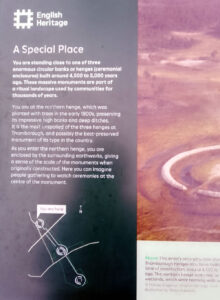
Transcript:
A Special Place
You are standing close to one of three enormous circular banks or henges (ceremonial enclosure) built around 4,500 to 5,000 years ago. These massive monuments are part of a ritual landscape used by communities for thousands of years.
You are at the northern henge, which was planted with trees in the early 1800s, preserving its impressive high banks and deep ditches. it is the most unspoiled of the three henges at Thornborough, and possibly the best preserved monument of its type in the country.
As you enter the northern henge, you are enclosed by the surrounding earthworks, giving aa sense of the scale of the monuments when originally constructed. Here you can imagine people gathering to watch ceremonies at the centre of the monumaent.
Geometrical and Astronomical Interpretation of the Henges
TBC
0 Comments